
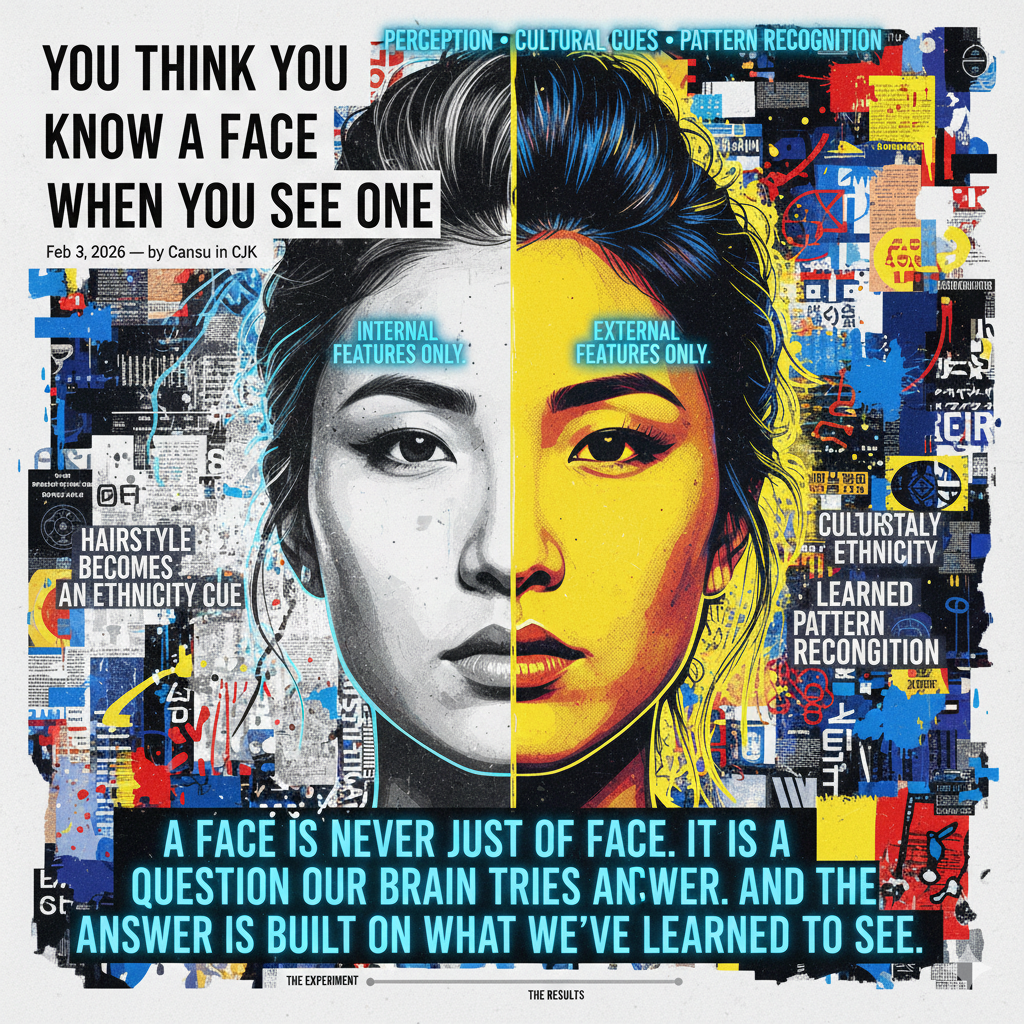
On external features, cultural cues, and the confidence we shouldn’t have
A face is never just a face.
When you see someone on the street, on a screen, across a café — your brain doesn’t just see them. It asks questions. Where are they from? Can I trust them? Are they like me?
And before you’ve even registered it consciously, your brain has already answered.But what if I told you that the answer is built on hair more than eyes?
That the inference you made was drawn from style more than structure?
That you think you’re reading a face, but you’re actually reading a signal — cultural, learned, and often wrong?
The Experiment
We asked 157 Koreans a simple question:
Can you tell Korean, Japanese, and Chinese faces apart?
Before we even started, they were confident. Of course we can, they said. We see these faces every day.
Then we showed them 600 faces — football players from Korea, Japan, and China. All male. All grayscale. All stripped of context.
And we did something unusual:
We split the faces into three versions.
Version 1: Internal features only.
Eyes. Nose. Mouth. The biology of the face.
Version 2: External features only.
Hair. Hairline. Face outline. The style of the face.
Version 3: The full face.
Everything together.
Now guess: which version worked best?
The Results (Or: When Confidence Meets Reality)
Internal features alone?
Barely better than guessing.
Around 40% accuracy — when chance is 33%.
Your eyes, your nose, your mouth? They tell almost nothing about whether you’re Korean, Japanese, or Chinese. The biological signals are too subtle, too overlapping, too ambiguous.
But add hair?
Suddenly, accuracy jumps to ~50-55%.
Not great. Still modest. But significantly better.
And here’s the kicker: showing only external features (hair, face shape) performed just as well as showing the full face.
Translation?
You don’t need to see someone’s eyes to categorize their ethnicity. You just need to see their hair.
What We’re Really Seeing
So what’s happening here?
When people look at a face, they’re not just detecting morphology — the shape of features, the distance between eyes, the curve of a nose.
They’re detecting style cues.
Grooming patterns. Hairstyle norms. Contemporary trends.
Cultural signals that say, “People from this place tend to look like this.”
And when biology gives you nothing — when the eyes and nose are too similar across groups — your brain leans hard on those external markers.
Hairstyle becomes an ethnicity cue.
Face outline becomes a cultural signature.
And the inference you make? It’s not about what the face is. It’s about what the face signals.This is not a neutral perception.
This is culturally learned pattern recognition, dressed up as biological intuition.
The Confidence Problem
Before the experiment, participants were sure they could do this.
“I can tell Korean and Japanese faces apart easily.”
After the experiment?
Their confidence collapsed.
Especially for Chinese faces — the hardest category, the one with the most ambiguity, the one that got confused with Japanese faces most often.
What we saw here is a textbook case of the Dunning-Kruger effect:
When you don’t know how hard something is, you overestimate your ability.
But once you try and fail, you recalibrate.
The lesson?
Introspection without experience is just optimism.
Why Japanese Faces Were “Easier”
One pattern stood out:
Japanese faces were categorized more accurately than Korean or Chinese faces — by a significant margin.
Why?
Not because Japanese people have more “distinctive” biological features.
But because the external cues associated with Japanese faces in our dataset were more diagnostic.
Maybe it’s hairstyle trends.
Maybe it’s grooming conventions.
Maybe it’s the way contemporary Japanese football culture visually differs from Korean or Chinese aesthetics.
Whatever it is, it’s not in the eyes or nose.
It’s in the presentation.
And that tells us something crucial:
Fine-grained ethnicity categorization is not about detecting racial essence. It’s about recognizing culturally patterned styles.
What This Means (And Why It Matters)
We live in a world where people believe they can “just tell” where someone is from.
Where ethnicity feels obvious, intuitive, natural.
But our study shows:
It’s not.
Even among closely related groups — even when people share geographic proximity, similar phenotypes, overlapping histories — the signals we use to categorize are:
✗ Not biological
✗ Not stable
✗ Not reliable
✓ They are cultural.
✓ They are learned.
✓ They are contingent on style, grooming, and contemporary trends.
And here’s the part that connects back to the manifesto:
We are made of inference.
When you see a face and “know” it’s Korean, Japanese, or Chinese — you’re not seeing ethnicity.
You’re inferring it.
And those inferences are built on:
- Hairstyle norms you’ve absorbed
- Grooming patterns you’ve noticed
- Cultural conventions you’ve internalized
You think you’re reading a face.
But you’re reading a world.
The Feedback Loop
And this is where it gets dangerous.
Because when we infer someone’s ethnicity based on external style cues, we don’t just passively observe them.
We treat them differently.
We make assumptions about:
- Their language
- Their behavior
- Their trustworthiness
- Their belonging
And those assumptions shape how they’re treated, and eventually, who they become.
Our inferences create reality.
When you categorize someone as “foreign” based on their hair, you’ve just shifted:
- How you speak to them
- Whether you trust them
- Whether they feel they belong
And they feel it.
So What Do We Do?
First: Recognize the ambiguity.
If trained participants in a controlled lab can only hit ~50% accuracy even with external cues, then maybe — just maybe — our everyday certainty about “who’s who” is overconfident.
Second: Question the signals.
When you “just know” someone’s ethnicity, ask yourself:
Am I reading their face, or am I reading their hairstyle?
Am I detecting biology, or am I detecting style?
Am I seeing them, or am I seeing my own learned expectations?
Third: Remember the stakes.These inferences aren’t just perceptual errors.
They’re social actions with real consequences.
Final Thought
A face is never just a face.
It is a question our brain tries to answer.
And the answer we give — the inference we make — is built less on what’s there and more on what we’ve learned to see.
External features. Cultural cues. Patterned expectations.This is how we build the social world.
One inference at a time.
Leave a Reply